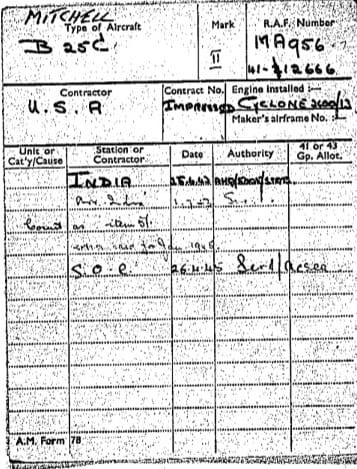
The North American B-25 Mitchell is an American medium bomber that was introduced in 1941 and named in honor of Brigadier General William "Billy" Mitchell, a pioneer of U.S. military aviation.[2] Used by many Allied air forces, the B-25 served in every theater of World War II, and after the war ended, many remained in service, operating across four decades. Produced in numerous variants, nearly 10,000 B-25s were built.[1] It was the most-produced American medium bomber and the third-most-produced American bomber overall. These included several limited models such as the F-10 reconnaissance aircraft, the AT-24 crew trainer, and the United States Marine Corps' PBJ-1 patrol bomber.
Design and development
On 11 March 1939, the US Army Air Corps issued Proposal No. 39-640 specifying a medium bomber capable of carrying a 3,000 lb (1,400 kg) bombload over a range of 2,000 miles (3,200 km) at top speed in excess of 300 mph (480 km/h). North American Aviation (NAA) used its NA-40B design to develop the NA-62 proposal. More state of the art compared to the competing Martin No. 179 proposal, the North American team included easy field maintenance and repair features, and according to Avery, "It promised to be an easy airplane to fly and placed no special requirements on pilot training programs." On 20 September. the Air Corps issued North American contract No. W353-ac-13258 for 184 B-25s powered by the Wright R-2600. The plane used the NACA 23017 airfoil at the wing root changing to a NACA 4409-R at the wingtip. On 19 August 1940, Vance Breese and NAA test engineer Roy Ferren flew the first flight test, when Ferren noted a severe roll-yaw condition.[3]